Your Appeal Deadline Is Already Running
The EDD mailed your denial or formal overpayment notice days ago. The 30-day appeal clock starts from the mailing date — not the day it reaches your mailbox. A Notice of Potential Overpayment has a separate 15-day response deadline. By the time you read your notice, a third of your window may already be gone.
And the notice itself is no help. It tells you to file Form DE 1000M, but it does not tell you how to write the appeal statement, what evidence to gather for a hearing you have never been through, or that the overpayment process can involve two deadlines at different stages: a 15-day response to a Notice of Potential Overpayment and, if EDD later issues a formal decision, a 30-day appeal window.
The California Unemployment Appeal Navigator is a step-by-step process guide that organizes every deadline, document, and decision point between receiving your determination notice and walking out of your CUIAB hearing. It is not legal advice. It is the procedural roadmap the EDD does not give you — with fillable tracking worksheets so nothing slips through a deadline you did not know was running.
What's Inside
A 46-page guide plus seven standalone printable worksheets and a 2-page checklist — 9 PDFs total.
Notice and Deadline Triage Log
Decode the determination codes on Form DE 1080CZ or formal overpayment notices (Form DE 1444/DE 1444CT or DE 1480), calculate your exact 30-day appeal deadline from the mailing date (not the delivery date), and log proof of mailing for every document you send. The log also tracks the separate 15-day response to a Notice of Potential Overpayment (Form DE 1447). When the appeal window is 30 calendar days and the postal service used 8 of them, knowing which date actually counts is the difference between a valid appeal and a rejected one.
Appeal Filing Walkthrough
Step-by-step instructions for completing Form DE 1000M — what goes in each field, how to write a clear factual statement that addresses the specific disqualification code on your notice, and how to mail it to the EDD address on your notice. Includes a late-filing good-cause framework for people whose notice arrived after a significant portion of the 30-day window had already passed.
Hearing Evidence Organizer
A pre-indexed exhibit cover sheet, chronological timeline template, and document checklist built around what CUIAB Administrative Law Judges need during a hearing. Most CUIAB cases are allotted 45 minutes to one hour. Instead of handing the judge a stack of unsorted papers, you present numbered exhibits tied to a timeline — pay stubs, termination letters, text messages, performance reviews, and medical records, each tagged to the specific issue in your case.
Witness Preparation Checklist
How to identify witnesses who can help your case, what to tell them before the hearing, how the ALJ's questioning works during a telephone hearing, and what cross-examination looks like when you are representing yourself. Most self-represented claimants walk into their first hearing without knowing they can call witnesses or that the employer's witnesses will be asked to testify — this worksheet walks you through both sides.
Overpayment Dual-Track Map
The overpayment process can start with a Notice of Potential Overpayment (Form DE 1447), which requires a response within 15 days. If EDD includes an Application for Overpayment Waiver (Form DE 1446UI) with that notice, complete and return it as instructed. If EDD later sends a formal Notice of Overpayment (Form DE 1444/DE 1444CT) or Notice of Denial of Benefits and Overpayment (Form DE 1480), you have 30 days from the mailing date to appeal. This flowchart tracks the response, any accompanying waiver application, and a later appeal in separate steps.
Certification Tracking Log
A structured log to record any continued claim forms and certifications EDD makes available while your appeal is pending. Continue to certify for benefits while your appeal is pending. Benefits can only be paid for weeks you certified and are otherwise eligible to receive.
Second-Level Appeal Reference
If the ALJ rules against you, you have 30 days to file a second-level appeal with the CUIAB Appeals Board — and then judicial review in Superior Court if the Board also denies. The guide explains each escalation path, what the Board actually reviews (questions of law, not just rehearing the facts), and how to request and listen to your hearing recording through the myAppeal portal before deciding whether to appeal further.
Who This Guide Is For
- You received Form DE 1080CZ (determination), DE 1447 (potential overpayment notice), or a formal overpayment notice (DE 1444/DE 1444CT or DE 1480) and need to identify the response or appeal deadline
- You have a CUIAB hearing scheduled and need to organize your evidence and prepare for the ALJ's questions
- You received an overpayment notice and are not sure whether to appeal, request a waiver, or both
- You won your appeal and want to understand your options for a second-level Board appeal or judicial review
- You are helping a family member or friend navigate their California unemployment appeal
Why the Free Resources Are Not Enough
The EDD's appeals page at edd.ca.gov explains the basic rules and links to Form DE 1000M. The CUIAB's hearing guide explains what happens in the hearing room. Legal Aid at Work publishes excellent fact sheets on hearing preparation and Board appeals. All of this is free, and you should read it.
What none of it provides is a personal workflow. The EDD page tells you the deadline is 30 days from the mailing date — but does not give you a log to calculate and track that date across multiple notices. The hearing guide explains that exhibits should be organized — but does not give you a numbered cover sheet built around the exhibit categories ALJs expect. The overpayment page explains the potential-notice response and waiver, then the appeal window for a later formal decision — but does not give you separate deadline checklists for tracking those steps.
This guide turns those rules into fillable tracking tools: the deadline triage log, the exhibit organizer, the dual-track overpayment map, the certification tracker. You are not paying for information the EDD already publishes for free. You are paying for the organizational system that turns that information into a case file you can actually manage under deadline pressure.
Free Help Exists — and This Guide Points You to It
Legal Aid at Work offers free information through its Workers' Rights Clinic, and its unemployment program may provide legal advice and representation before CUIAB if you qualify. Regional legal aid offices — Bet Tzedek, Bay Area Legal Aid, Neighborhood Legal Services — handle unemployment cases for low-income claimants. The CUIAB myAppeal portal lets you track your appeal status, submit exhibits, and file second-level appeals online. The guide lists Legal Aid at Work and Neighborhood Legal Services of Los Angeles County with contact information.
If you qualify for free legal representation, get it — a trained advocate at your hearing is better than any self-help guide. This toolkit is for the many claimants who fall outside legal aid's income limits, cannot afford a private attorney, and need to organize their own case.
Satisfaction Guarantee
Full refund, no time limit. If the guide does not help you, email [email protected] and we will process it — no forms, no questions.
Get Started
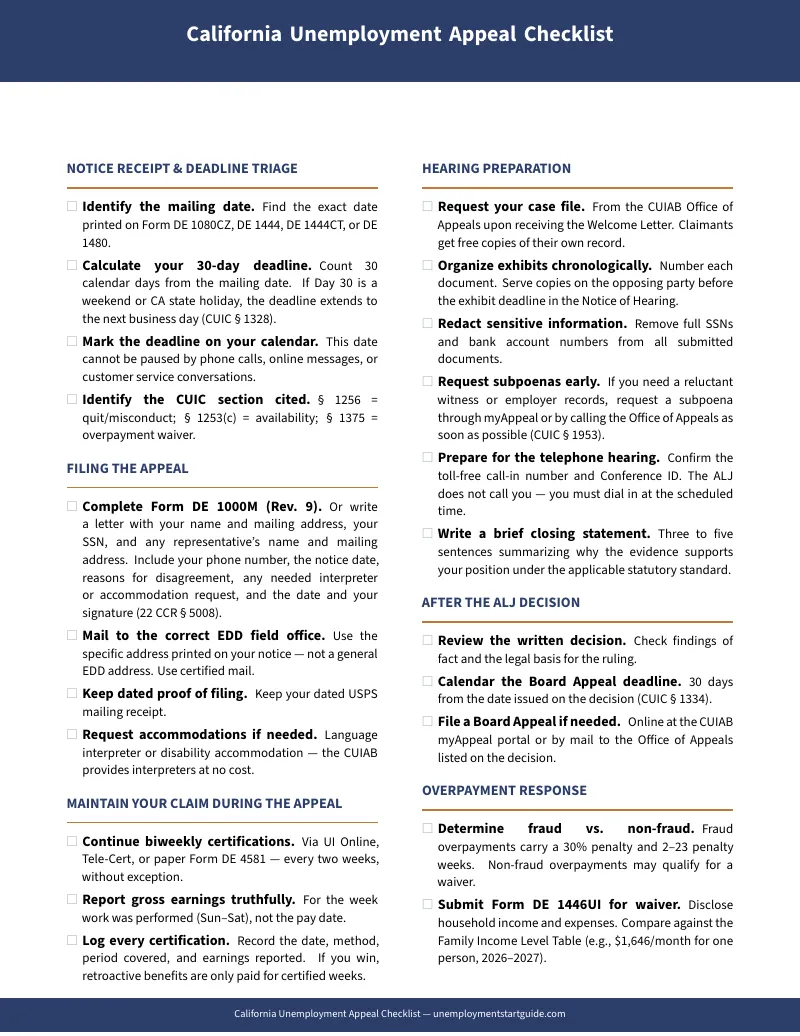
Download the free California Unemployment Appeal Checklist — a 2-page summary of the deadlines, documents, and hearing steps you need. If you want the full system — the 46-page guide plus seven standalone printable worksheets including the exhibit organizer, the dual-track overpayment map, the witness checklist, and the certification tracker — get the complete Unemployment Appeals in California toolkit for .
Frequently Asked Questions
What if the rules change after I buy?
We update the guide when the rules change. Email us any time, even years later, and we'll send you the current edition free.